Friday, January 18, 2013

TIMES BETWEEN BRITAIN'S PROVINCIAL CITIES SLASHED BY HALF

• Department for Transport expected to confirm latest route within weeks
• Journey times between major cities in the North will be slashed by half
• DfT hopes service will transform the North, but critics believe many passengers may be priced out

By James Rush

PUBLISHED: 04:20 EST, 18 January 2013 | UPDATED: 05:10 EST, 18 January 2013 The full impact across the country of the £33bn high-speed rail project is to be unveiled by the Government within weeks, it has been reported. Passengers between major cities will see journey times slashed, by half in many cases, by the second phase of the project.

The Department for Transport will detail its calculations of the effect on provincial Britain when it confirms the route for the latest stage, which takes the line to Leeds and Manchester.

Passengers between major cities will see journey times slashed, by half in many cases, by the second phase of the high-speed rail project.

The new 225mph trains will see journey times slashed dramatically between the UK's provincial cities, according to The Telegraph.

The Government believes the North's economy will be transformed, but critics believe many passengers could be priced out of using the trains, if a high-speed premium is charged.

Graham Stringer, Labour MP for Blackley and Broughton, said the HS2 second phase announcement was a 'watershed moment' for Britain.

He said: 'What HS2 will do is bring the North and the Midlands closer together, creating a new economic hub that, for the first time in our history, will provide some proper competition to London.

'That can only be good news – not just for the cities themselves but for the country as a whole.'

The first stage of HS2 from Euston to Birmingham is due to open in 2026, with the second stage expected to be completed in another six years. Passengers travelling from Birmingham to Manchester will see their journey time cut from 88 minutes to 49, while those going further north to Newcastle will spend 127 minutes on the trip, compared with the current 194.

Meanwhile, a journey between Leeds and Nottingham will fall from 115 minutes to 29, and those travelling to Sheffield will fall to 17 minutes from 41.

Critics have warned many passengers could be priced out of using the trains, if a premium is charged for using the high-speed service

HOW JOURNEY TIMES WILL BE CUT BY THE HIGH-SPEED RAIL

Trains from London to:

Birmingham - reduced from 1 hour 24 minutes to 49 minutes
Manchester - reduced from 2 hours 8 minutes to 1 hour 8 minutes
Leeds - reduced from 2 hour 12 minutes to 1 hour 22 minutes
Glasgow - reduced from 4 hours 8 minutes to 3 hours 38 minutes

Trains from Birmingham to:

Leeds - reduced from 2 hours 3 minutes to 57 minutes
Sheffield - reduced from 1 hour 11 minutes to 38 minutes
Manchester - reduced from 1 hour 28 minutes to 49 minutes
Glasgow - reduced from 3 hour 57 minutes to 3 hour 22 minutes

Trains from Leeds to:

Sheffield - reduced from 41 minutes to 17 minutes
Nottingham - reduced from 1 hour 55 minutes to 29 minutes

CALIFORNIA-AMTRAK TEAM UP FOR HIGH-SPEED RAIL

California works with Amtrak to make high-speed rail

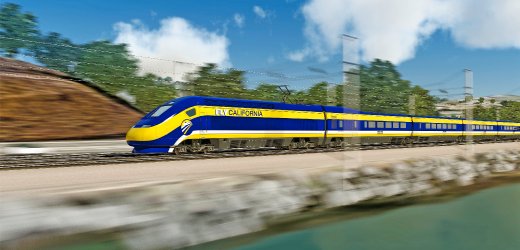
The sleek animation shows what high-speed rail travel in California could look like in 20 years or so. Trains moving at up to 220 miles an hour would passengers between Los Angeles and San Francisco in just two hours and 40 minutes. / CBS News/CA High-Speed Rail Authority

WASHINGTON The two biggest players in the nation's pursuit of high-speed rail said Thursday they'll work together to search for trains that will operate at up to 220 miles per hour along both coasts of the United States.

Officials with Amtrak and the California High-Speed Rail Authority said they envision that the two systems will purchase about 60 trains over the next decade. The first order could take place next year.

The aim is for manufacturers to design trains that will work for both systems. In the process, their combined buying power should generate better pricing from manufacturers. "By combining our buying power, potentially, we can drive the market in a way that we can't if we purchase separately," said Jeff Morales, CEO of the California High-Speed Rail Authority.

• World's longest high-speed rail line opens in China

• Judge backs Calif. high-speed rail over farmers

• High-speed Chicago to St. Louis train hits 111 mph

California is expected to begin construction on its high-speed rail in the summer. The first 65-mile segment will run from Merced to Fresno.

The high-speed rail efforts in California have come under increased scrutiny by members of Congress who say it has become too expensive to build and operate. The more ties it has with Amtrak, the better its future prospects might be, but officials said the announcement was not designed to bolster high-speed rail in California.

"It doesn't make any sense whatsoever to go out and have a different set of standards for California or any other high-speed train," said Amtrak President and CEO Joe Boardman. "So, no, it's about doing the right thing for the United States."

Morales said the high-speed line that would serve California has much in common with Amtrak's Northeast Corridor in terms of population, traffic congestion and economic output.

"If the case is there for investing in the Northeast, that same case can be made for the West Coast and California. We think there's very good reason to look at them as a pair," Morales said. "That's something we're talking to Amtrak about, to align our interests where it makes senses to align them."

© 2013 The Associated Press. All Rights Reserved. This material may not be published, broadcast, rewritten, or redistributed.

PHOTOVOLTAIC ELECTRICITY AND BEVs SUN-TO-WHEELS PATHWAYS

Lee,

The arguments can be quibbled with… and are (from various sources with other vested interests)… but these guys do indeed make a point that could easily apply to a MagLev HSR system if it is run as an on-demand active track system. The motivations may be a bit from left field, but direct conversion back to direct use makes sense in terms of round-trip system efficiency.

At 24% to 36% efficiency, internal combustion systems are not very competitive with direct electric propulsion. But that’s just the consumption side of the problem. The other side of the issue is the conversion from solar to fuel. Again, they have a point that bio fuel based systems are not going to be competitive there either. Comparing biofuel systems and their associated conversion losses In/Out, the current PV numbers win.

The newer model low-reflectance panels (carbon nano rod and nano lattice gold) will add to the PV efficiency and the multi-layer methods will add even more. And thus far, nobody has put the two approaches together to see just how far the collection efficiency for PV can be pushed. That needs to be done to see where the kilowatt capture numbers will land.

Even 30 minute dispatch times for the HSR would not tax a good PV system with a battery storage energy holding arrangement. The track is going to be off most of the time anyway. Only the activated sections need to be switched on and left running in anticipation of a transit event. At 300 mph the MagLev would be moving at 5 miles per minute. A one minute buffer would translate to 5 miles of activated track. A two minute buffer would equal 10 miles… etc.. Transit buffer lengths could be predicated on safety response times for the engineer-operator and the safe stopping distance needed under full load conditions during Summer operations.

Either way, the PV approach for segment activated track needs to be looked at for systemic efficiency since they would be off most of the time and would have plenty of recharge time between transit events.

Personally, I don’t buy into the greenhouse gas emissions arguments that are used these days. The only argument that counts is bottom line cost-per-transit. The cheapest way to achieve the lowest operating cost is the lodestar that should guide the design approach. Diesel electric has been around for a long time now and has proven to be very efficient for normal hard rail operations. There is a reason why they use it. It’s cheaper. Now automobiles are moving in that same direction. But if an all electric operation method can ace the hybrid approach, then for on-going operations that should be considered. Again, repetitive bottom line use/cost per transit would be the ultimate issue. Having the Sun as an operating partner (cost reduction) does make a certain amount of sense.

Any news?

Regards,

Gill E.

Spatially explicit life cycle assessment of 5 sun-to-wheels pathways finds photovoltaic electricity and BEVs offer land-efficient and low-carbon transportation 4 January 2013Mp

http://www.greencarcongress.com/2013/01/geyer-20130104.html

A new spatially-explicit life cycle assessment of five different “sun-to-wheels” conversion pathways—ethanol from corn or switchgrass for internal combustion vehicles (ICVs); electricity from corn or switchgrass for battery-electric vehicles (BEVs); and photovoltaic electricity for BEVs—found a strong case for PV BEVs.

According to the findings by the team from the University of California, Santa Barbara and the Norwegian University of Science and Technology, published in the ACS journal Environmental Science & Technology, even the most land-use efficient biomass-based pathway (i.e., switchgrass bioelectricity in US counties with hypothetical crop yields of more than 24 tonnes/ha) requires 29 times more land than the PV-based alternative in the same locations.

Direct land use, life cycle GHG emissions (excluding indirect land use change), and life cycle fossil fuel requirements to generate the transportation services provided by 17.8 × 10¹² MJ NCV of gasoline, the amount used in transportation in the US in 2009. Credit: ACS, Geyer et al.

Furthermore, PV BEV systems also have the lowest life cycle GHG emissions throughout the US and the lowest fossil fuel inputs, except for locations with hypothetical switchgrass yields of 16 or more tonnes/ha. Including indirect land use effects further strengthens the case for PV BEVs, the researchers suggested.

Biofuels for ICVs and bioelectricity for BEVs use photosynthesis to convert solar radiation into transportation services, that is, they are sun-to-wheels transportation pathways. While photosynthesis has a theoretical maximum energy conversion efficiency of 33%, the overall conversion efficiency of sunlight into terrestrial biomass is typically below 1%, regardless of crop type and growing conditions. Therefore any biomass-based energy pathway is very land-use-intensive. As a result, biomass-based transportation pathways are increasingly seen as a threat to food supply and natural habitats.

A third type of sun-to-wheels pathway is the use of photovoltaics (PV) to convert sunlight directly into electricity for BEVs...Existing environmental assessments of biofuels and photovoltaic energy pathways use average biomass and PV yields, even though these yields vary widely between geographical locations. Spatially-explicit assessments are more informative, since pathway performance depends on location, and land use decisions are always local by nature. This article presents life cycle assessments of five different sun-to-wheels conversion pathways for every county in the contiguous U.S: Ethanol from corn or switchgrass for ICVs, bioelectricity from corn or switchgrass for BEVs, and PV electricity for BEVs using cadmium telluride (CdTe) solar cells. The assessments include the production and use of the transportation energy (the fuel cycle) and the life cycle of the vehicle.

—Geyer et al.

The functional unit of the assessment was 100 km driven in a compact passenger vehicle during one year. The team calculated three environmental indicators for each county of the contiguous US:

1. Land area required for the corn and switchgrass fields or the PV installation—i.e., direct land use measured in m2/100 km driven.

2. Total global warming potential from the vehicle and fuel life cycles, measured in kg CO2 equiv/100 km driven.

3. Total fossil fuel consumption from the vehicle and fuel life cycles, measured in MJ of net calorific value (NCV) per 100 km driven.

The system boundary includes vehicle production, use, and end-of-life management, as well as fuel production and use. In the case of PV electricity, the fuel cycle consists of production, use, and end-of-life management of the PV system.

GHG and fossil fuel data for the production of corn and switchgrass and their conversion to ethanol are based on the EBAMM Model, which was combined with crop yield maps and updated with data from version 1.8c.0 of the GREET model and other recent literature. Among the assumptions were:

· NCV of corn and switchgrass is 18 MJ per kg, and that 2.53 kg of corn and 2.62 kg of switchgrass are required to produce 1 L of ethanol with 21.2 MJ NCV.

· Energy consumption and GHG emission values of the biorefineries include coproduction credits and in- and out-bound logistics. The crop-to-electricity conversion model assumes that half of the biomass is converted in biomass boilers and the other half is co-combusted with coal to generate electricity.

· Inventory models for both product systems are based on Ecoinvent data and reports. A biomass-to- electricity conversion efficiency of 32% was used, and an electricity transmission and distribution efficiency of 92%.

· The PV system life cycle is based on 2005 technology and production data.

Economic input−output life cycle assessment (EIOLCA) was used to derive energy and GHG values for the production of a compact ICV; data on 2005 Li-ion battery technology was added to model PHEVs of equivalent size. The resulting energy and GHG values are 102,000 MJ and 8,500 kg CO2eq per compact ICV, and 1700 MJ and 120 kg CO2 equiv/kWh of Li-ion battery.

A 150 km (93-mile) -range BEV model was derived by increasing the battery size in the PHEV model. This may overestimate GHG emissions and fossil fuel consumption of BEV production, the researchers noted, since they merely added the battery to an ICV and did not deduct the internal combustion engine or related components.

Together with the maximum range of 150 km and a maximum depth of discharge (DOD) of 0.8, the BEV energy demand translates into a required battery size of 33.75 kWh. The life cycle mileage of both vehicles is assumed to be 240,000 km (149,000 miles).

Among their findings were that relative to the gasoline baseline, the PV and switchgrass scenarios would also reduce associated GHG emissions and fossil fuel consumption from production and use of vehicles and fuels by 75−80% relative to gasoline ICVs. The PV-based pathway would reduce life cycle GHG emissions, including vehicle production, by almost 80%, from 1.92 to 0.41 billion tons of CO2 equiv.

Vehicles powered with switchgrass electricity or ethanol come second and third with 0.46 and 0.48 billion tons of CO2 equiv, yet these numbers do not include any GHG emissions from indirect land use change, the researchers noted.

The three sun-to-wheels pathways with the lowest fossil fuel requirements are switchgrass ethanol for ICVs; switchgrass electricity for BEVs; and PV electricity for BEVs; with 4.7, 5.4, and 5.2 trillion MJ.

For both BEV-based pathways, more than 85% of fossil fuels are consumed during vehicle production. Of all the 5 sun-to-wheels systems, corn ethanol for ICVs had by far the highest land requirements, GHG emissions, and fossil fuel requirements.

Assuming that the economics of PV and BEV technology will further improve and issues of material availability, and electricity transmission and storage can be resolved, PV offers land-efficient and low-carbon sun-to-wheels transportation. Unlike fuel crops, PV electricity does not have to compete with food production and biodiversity for fertile land and could potentially replace all gasoline used in US transportation.

—Geyer et al.

Resources

· Roland Geyer, David Stoms, and James Kallaos (2012) Spatially-Explicit Life Cycle Assessment of Sun-to-Wheels Transportation Pathways in the US. Environmental Science & Technology doi: 10.1021/es302959h

Friday, December 2, 2011

High-speed Rail Is a Fast Way to Waste Taxpayer Money

By Michael Barone
January 20, 2011 6:35 am
The Washington Examiner

Where can the new Congress start cutting spending? Here’s one obvious answer: high-speed rail. The Obama administration is sending billions of stimulus dollars around the country for rail projects that make no sense and that, if they are ever built, will be a drag on taxpayers indefinitely.


When incoming Govs. Scott Walker of Wisconsin and John Kasich of Ohio cancelled high-speed rail projects, Transportation Secretary Ray LaHood refused to let them spend the dollars on other forms of transportation and sent the funds instead to California and other states.


Walker argued that Wisconsin didn’t need $810 billion for a 78-mile line between Madison and Milwaukee because there’s already a transportation artery — Interstate 94 — that enables people to get from one city to the other in a little more than an hour (I once drove that route to have dinner in Milwaukee).


Kasich’s rationale? “They tried to give us $400 million to build a high-speed train that goes 39 miles an hour.” Train boosters countered that its top speed was 79 miles per hour — about the same as many drivers on Interstate 71.


High-speed rail may sound like a good idea. It works, and reportedly even makes a profit, in Japan and France. If they can do it, why can’t we?


A look at some proposed projects gives the answer. Take the $2.7 billion, 84-mile line connecting Orlando and Tampa that incoming Florida Gov. Rick Scott is mulling over.


It would connect two highly decentralized metro areas that are already connected by Interstate 4. Urban scholar Wendell Cox, writing for the Reason Foundation, found that just about any door-to-door trip between the two metro areas would actually take longer by train than by auto — and would cost more. Why would any business traveler take the train?


As for tourists headed for Orlando’s theme parks, there is already a convenient rental car operation, with some of the nation’s lowest rates, at the Orlando airport. Why would parents get on a train, pay a separate fare for each kid and then rent a car at the station when you could more easily get one at the airport?


As Cox points out, cost estimates for the Florida train seem underestimated and the ridership estimates seem wildly inflated. If he’s even partially right, Florida taxpayers will be paying billions for this white elephant over the years.


Other projects seem just as iffy. California is spending $4.3 billion on a 65-mile stretch of track between Corcoran and Borden in the Central Valley, which is supposed to be part of an 800-mile network connecting San Diego and Sacramento. Its projected cost was $32 billion in 2008 and $42 billion in 2009, suggesting a certain lack of precision.


Or consider the $1.1 billion track improvement on the Chicago-St. Louis line in Illinois. It would reduce travel time between the cities by 48 minutes, but the trip would still take over four and a half hours at an average speed of 62 miles per hour.


None of these high-speed projects are really high-speed. Japan has bullet trains that average 171 miles per hour, France’s TGV averages 149 miles per hour. At such speeds you can travel faster door-to-door by train than by plane over distances up to 500 miles.


In contrast, Amtrak’s Acela from Baltimore to Washington averages 84 miles per hour and the Orlando-Tampa train would average 101 miles per hour. That makes the train uncompetitive with planes on trips more than 300 miles.


Now take a look at your map and see how many major metro areas with densely concentrated central business districts and large numbers of business travelers are within 300 miles of each other.


The answer is not very many outside of the Northeast Corridor between Washington and Boston. Our geography is different from France’s or Japan’s.


Moreover, to achieve the speed of French and Japanese high-speed rail, you need dedicated track so you don’t have to slow down for freight trains. To get dedicated track, you need a central government that is willing and able to ignore environmental protests and not-in-my-backyard activists. Japan and France have such governments. We don’t.


So we are spending billions on high-speed rail that isn’t really high speed, that will serve largely affluent business travelers and that will need taxpayer subsidies forever. This should be a no-brainer for a Congress bent on cutting spending.


—

Michael Barone, senior political analyst for The Washington Examiner (www.washingtonexaminer.com), is a resident fellow at the American Enterprise Institute, a Fox News Channel contributor and a co-author of The Almanac of American Politics.

http://www.gopusa.com/commentary/2011/01/20/barone-high-speed-rail-is-a-fast-way-to-waste-taxpayer-money/

Wednesday, November 16, 2011

Bullet Train Boondoggle

By Marilyn M. Barnewall
September 19, 2010
NewsWithViews.com


The history of American high-speed rail may someday read like the history of American toilet paper.

I support high-speed rail (HSR) – properly done. That means a national system built by private investors, not rapid transit or some other excuse for rail service built here and there by a power-hungry federal government buying votes.

Like most things, toilet paper was not widely accepted until a new technology demanded it – sit-down flush toilets with indoor plumbing systems. And toilet paper solved a problem. Hotels found it a particularly helpful product. It made public restrooms accommodating – did the job.

So what does the history of toilet paper have to do with the current history of a new technology called high-speed rail? HSR is not new – the Japanese have had bullet trains since the 1960s. But it’s new to America. The reason it’s new is a political system that is power hungry and it doesn’t support what benefits the nation and the people.

My first high-speed rail article appeared in NewsWithViews on June 28, 2009. I wrote about the importance of private investors building it… we don’t need another industry taken over by government. They already own banks, insurance companies, the auto industry, healthcare – and we await the second shoe to fall on cap and trade. Since government owns the interstate highway system, owning HSR connects all the transportation system dots. With high-speed rail in its pocket, government can easily manipulate airlines… and movement. No. Forget toilet paper. I’m talking about the movement of citizens.

On February 3, 2010, I wrote another high-speed rail article. In that article, I said: “To make what I’m saying very clear, the Obama Administration is lying – intentionally or otherwise – to the American people.”

I pointed out that HSR bullet trains go 222 miles per hour (mph). During Obama’s State of the Union Speech a few days earlier, he announced a “high-speed rail” project in Florida: Tampa to Orlando. The two cities are 85 miles apart. Such short trips are usually (not always) rapid transit – which costs far less than HSR. From the cost estimates, American taxpayers may pay for HSR but will get the less expensive alternative: Rapid transit rail (RTR).

My Canada Free Press HSR article of October 26, 2009 noted: “The average speed of HSR trains is between 150 and 250 mph… RTR averages between 100 and 150 mph and traditional rail (Amtrak) averages from zero to 100 mph. HSR moves people across long distances very quickly. RTR takes people from a central HSR depot to a variety of locations.” In other words, HSR should be built right down the middle of the Florida peninsula – through Orlando continuing on to Miami – while RTR carries passengers from Orlando to Tampa. That’s a high-speed rail system. A bullet train traveling at 222 mph should travel long distances between stops letting rapid transit take care of the short hops.

Sudden HSR Publicity

On August 30, 2010, the Chicago Tribune published an article about HSR. It quoted Illinois State Senator Martin Sandoval, D-Chicago, who is Chairman of the Illinois Senate Transportation Committee. He said about the Administration’s promise of 110 mph rapid transit trains: “Bullet trains routinely operate at 150 to 220 mph. It's the performance level Illinois should be shooting for.”

Sandoval pointed out that Amtrak has “minimal expertise” with HSR but they don’t see a problem “at topping out at only 110 mph.” Of course they don’t! As the Tribune article points out, billions of dollars injected into Midwest rail service means saving a lot of Amtrak jobs. But that rail service is rapid transit or rapid rail, not HSR. Amtrak’s Acela Express that operates between Boston and Washington, D.C. gets up to 150 mph on small portions of that route… but that is RTR, not HSR.

The day after the Chicago Tribune article, Mark Belling, a guest host on Rush Limbaugh, did a ten minute monologue about high-speed rail and pork-barrel spending. Here’s what Belling said on the Limbaugh show, August 31, 2010:

“In my own state of Wisconsin, Obama is pushing a high-speed rail line between the cities of Milwaukee and Madison. They’re only 75 miles apart. When traffic is terrible it’s only a 90 minute drive… when it’s terrible. It’s usually a little bit less than that. It’s an annoying drive, but it’s do-able. He wants to put a high-speed bullet train there – a train that will go 115 miles per hour and maybe you’ll be able to complete the trip in an hour.

“The cost for this line – which is a little over 80 miles – is $810 million, paid for by the federal government. The leading Republican candidate for Governor in my state, Scott Walker, is running television ads saying he’ll kill the train if you elect him. Those ads are resonating across Wisconsin. He’s saying, ‘If you elect me, I’ll kill this pork they’re trying to give us’ – and he sees it as a winning political issue.”

Think about what Walker is saying. If government does high-speed rail, your state budget will have fewer dollars for busses and highways. You can find the Limbaugh radio transcript and the Chicago Tribune article at my HSR blog. My notes from a radio interview I did with Chuck Wilder are there and answer many high-speed rail questions.

The next week, the Boston Globe came out with a HSR article. What’s going on? I’ve been a lone voice on this for a long time. Regardless, the Globe article motivated me to do something I’ve been thinking about for some time.

I have decided that writing to Congressmen and U.S. Senators is a total waste of time. They don’t listen. If they did, they would not be so blind-sided by the emerging power of Tea Party groups. If we are going to force change, it must come at the state level. No one in Washington is listening, from the White House to Congress – and the Supreme Court has apparently lost its copy of the Constitution.

I wrote a letter about the high-speed rail boondoggle to every sitting Governor who will remain in office after the 2010 elections. And, I wrote to all Republican candidates running for governorships in all other states. I quoted the Tribune article and the Limbaugh monologue. I gave the address of my high-speed rail blog. They have the information.

While researching the names of gubernatorial candidates, I found that Ohio has been offered $400 million of our federal tax dollars for a train from Cincinnati to Cleveland via Columbus. One of John Kasich’s supporters (Kasich is running for Governor) sent me a 1935 train schedule proving the old steam engine used then made the trip in just over five hours. The Democrat plan gives Ohio a train that travels 39 mph and takes more than six hours to make the trip. It’s a four-hour drive.

You and I will pay for the $400 million boondoggle, but Ohio taxpayers will have to eat $17 million in red ink annually for years to come. No wonder Wisconsin’s gubernatorial candidate, Rick Walker, views this as an issue! He’s totally right!

NEWS ALERT (as Fox News would say): On September 13, 2010, a story from Reuters Shanghai announced “‘California will seek China's help in financing its high-speed rail system and welcomes bids from Chinese firms to help build it,’ Governor Arnold Schwarzenegger said on Monday.”

If you’re jobless, you might want to focus on Governor Schwarzenneger’s comments: "We look to China to build our high speed rail…" Schwarzenegger told a gathering of U.S. businesses in Shanghai.” In case you didn’t get that, he said “We look to China to BUILD…” not finance, build. Now that will create a lot of American jobs, won’t it?

California, which entered its fiscal year without a budget signed into law, has financial problems that prevent its moving ahead with high-speed rail. The state doesn’t have the money for HSR and apparently President Obama doesn’t either – or Schwarzenneger wouldn’t be in Shanghai looking for funding, would he?

Remember when Richard Nixon first went to China and was lauded for “opening” trade between the two nations? When Chou En Lai received Nixon, he said “you wouldn’t be here if you didn’t have something we want.” Who has prospered more economically since those meetings? China? Or, the U.S.? Chou evidently got what he wanted. What could the Chinese want from Governor Schwarzenneger: California’s high-speed rail system as collateral for their investment?

To find the reasons why we need high-speed rail, please visit my blog. We need to insist on HSR and defeat this attempt to shove rapid transit down our throats. Consider this: The United Nation’s Agenda 21 calls for permanently moving people from rural areas to cities. The U.N. wants nations to house people in controlled areas – cities with condos above office buildings and people riding bikes to work, not driving on streets and highways, etc. Rapid transit enables that.

Is that why Democrats support RTR and lie to Governors and the public telling them it’s HSR? RTR enables governments around the world to control the movement of people. And all that uninhabited land makes land trusts – like the ones former Treasury Secretary Henry Paulson and others are so invested in – very powerful and profitable.

Properly done, high-speed rail could provide two million new jobs within two years – but "properly done" is defined as bullet trains that cross the nation at 222 mph, not a local that’s really rapid rail and stops every 75 miles – the 110 mph Amtrak retread crap.
And that brings me back to the history of toilet paper.

It appears Washington wants to control our movements… including where and how we go. If that doesn’t scare the – whatever – out of you, it should.

© 2010 Marilyn M. Barnewall - All Rights Reserved
________________________________________
Marilyn MacGruder Barnewall began her career in 1956 as a journalist with the Wyoming Eagle in Cheyenne. During her 20 years (plus) as a banker and bank consultant, she wrote extensively for The American Banker, Bank Marketing Magazine, Trust Marketing Magazine, was U.S. Consulting Editor for Private Banker International (London/Dublin), and other major banking industry publications. She has written seven non-fiction books about banking and taught private banking at Colorado University for the American Bankers Association. She has authored seven banking books, one dog book, and one work of fiction (about banking, of course). She has served on numerous Boards in her community.

Barnewall is the former editor of The National Peace Officer Magazine and as a journalist has written guest editorials for the Denver Post, Rocky Mountain News and Newsweek, among others. On the Internet, she has written for News With Views, World Net Daily, Canada Free Press, Christian Business Daily, Business Reform, and others. She has been quoted in Time, Forbes, Wall Street Journal and other national and international publications. She can be found in Who's Who in America (2005-10), Who's Who of American Women (2006-10), Who's Who in Finance and Business (2006-10), and Who's Who in the World (2008).
Web site: Deleted by Google
E-Mail: marilynmacg@juno.com

Friday, August 12, 2011

Chinese Bullet Train Maker Orders Recall


August 12, 2011

By Joe McDonald

AP Business Writer


BEIJING (AP) — A Chinese bullet train manufacturer announced a recall Friday of 54 trains in the latest embarrassment for a problem-plagued prestige project following a July crash that killed 40 people.

The recall adds to growing signs official attitudes toward the bullet train are shifting and Beijing might scale back its rapid expansion of the high speed rail network. A moratorium on new rail projects was imposed this week and the government announced a reduction in train speeds.

The recall applies to model CRH380BL trains used on the new Beijing-Shanghai line, which has suffered repeated delays blamed on equipment failures, state-owned China North Locomotive and Rolling Stock Ltd. said in a statement through the Shanghai Stock Exchange.

It gave no indication the recall was linked to the fatal July 23 collision on a separate line in southern China. The company said it would carry out "comprehensive inspection and rectification" on the trains but gave no other details.

Beijing launched an overhaul of the multibillion-dollar high-speed network after the July crash prompted an avalanche of public complaints about the human cost of rapid, government-driven development.

CNR announced a temporary halt to production of CRH380BL trains this week. A state news agency cited a company manager as saying faulty sensors were believed to be to blame for the stoppages and experts were being sent to examine rail lines.

The bullet train was meant to showcase China's technological advancement and form the basis for possible exports. Chinese bullet train makers have sold rail cars to Malaysia and are working on projects in Turkey and Saudi Arabia.

But even before the July crash, the bullet train was a target of critics who said it was dangerously fast and too expensive for a society where the poor majority need more low-cost transportation, not record-setting speeds.

China has the world's biggest train network, with 56,000 miles (91,000 kilometers) of passenger rail. But trains are overloaded with passengers and cargo, and critics say the money would be better spent expanding slower routes.

Critics have expected changes since the bullet train lost its biggest official booster when the former railway minister was dismissed in February amid a graft probe.

Earlier plans called for expanding the network to 10,000 miles (16,000 kilometers) of track by 2020. Authorities have announced no changes but the railway ministry says it is spending less than planned this year on the high-speed system.

Authorities blamed the July crash on a lightning strike that caused one train to stall and a sensor failure that allowed a second train to keep moving on the same track and slam into it. That caused train cars to fall from a viaduct near the southern city of Wenzhou.

http://www.impomag.com/scripts/ShowPR.asp?RID=18553&et_cid=1938321&et_rid=89794715&linkid=http%3a%2f%2fwww.impomag.com%2fscripts%2fShowPR.asp%3fRID%3d18553&CommonCount=0

Tuesday, June 28, 2011

Proposed California High Speed Rail Route Cuts Through Farms to Protect Birds

By Michelle Macaluso

Published June 25, 2011| FoxNews.com
Reuters

The California High Speed Rail Authority is considering a new route for its cross-state system that will literally split farms in two, to avoid a bird sanctuary.


Mike Monteiro, owner of the Lakeside Dairy in Hanford, which is just about three miles down the road from the sanctuary, said he learned of the plan only through a concerned neighbor who warned that draft rail routes would split his land apart.


“It’s amazing to me that they’ve moved this rail across this farmland without any input from me or any of my neighbors on the impact that it’s going to have on my dairy,” said Monteiro, who owns 7,000 cattle on his thousand-acre farm. He’s certain that his business will be dramatically affected.

“The fact that I have three dairy operations that are going to be half on one side and half on the other (of the tracks), the transfer here on a daily basis is just going to be absolutely miserable for us,” he said.

Earlier projected maps showed two different alignments going through the Tulare Lake Bed, a wetlands-like region that attracts 200 species of birds, including waterfowl, gulls and shorebirds. Parts of the 1,300-acre region, maintained by the Kaweah Delta Water Conservation District (KDWCD), Corcoran Irrigation District and Central Valley Flood Protection Board provide a habitat for the birds and are recommended for protection by the U.S. Army Corps of Engineers and U.S. Fish and Wildlife Services.

When the conservation district heard about the proposed route, it informed the rail authority that such a move would significantly affect the area used by thousands of birds.

“If you’re interrupting that site, you’re impacting that particular species at stake,” said Sopac Mulholland, executive director of Sequoia Riverlands Trust, a conservation group that works in the region.

But farmers say they weren’t offered an opportunity to suggest a new rail route if their homes were affected.

“You’re saying that the species that are protected in that preserve are more important than us? And our property line can’t be sidestepped for us, but can for certain species that are deemed worthy but we're not?” said Anne Gaspar, another Hanford resident whose property is in the path of the railway.

The rail authority says they have a thorough environmental review process in which they must follow strict state and federal requirements.

“Over the last two years the authority has worked with communities in the Central Valley to gather feedback on the alternatives for the route, potential station locations and track design options,” Rachel Wall, the rail authority's press secretary, said in a written statement.

The rail authority will release the draft Environmental Impact Report and Environmental Impact Statement on the proposed route at the end of July. “This document will identify the potential impacts of each alternatives as well as proposed measures to mitigate those impacts,” Wall said.

Once the report is out, the Kings County residents, which include those in Hanford, will be given a 45-day public comment period. The several thousand-page report will outline the project level details and hopefully will bring answers to the concerned residents.

Gaspar’s husband, Steve, says he and other farmers are upset that the rail authority didn’t reached out to the community sooner, especially if revisions are made to the route.

“We need to be informed because this is going to displace, not even our homes, but our business, how we make a living, everything. And it would be very good if they come out talk to us answer the questions, and we would explain our situation here,” Gaspar said.

It is estimated that it will cost $45 billion to connect San Francisco to San Diego by high-speed rail. State and federal taxpayers will be footing most of the bill. Advocates of the high-speed rail argue that it will create thousands of jobs and will make California businesses more successful, thereby stimulating the economy.

http://www.foxnews.com/us/2011/06/25/high-speed-rail-routed-around-environmental-site-affects-new-group-farms/#ixzz1QXwKgG4Z

Tuesday, May 17, 2011

High-Speed Trains Fail to Impress

President Obama's dream of connecting 80 percent of Americans to a high-speed rail line appears to be dead. Congress appropriated $8 billion for high-speed rail in the 2009 stimulus bill and $2 billion more in the 2010 appropriations bill. But, after newly elected governors of Florida, Ohio and Wisconsin rejected high-speed rail projects in those states, Congress declined to include any more funds in 2011 and it is unlikely to spend any more on this boondoggle as long as Republicans have a hold on the House, says Randal O'Toole, a senior fellow with the Cato Institute.

What will Americans get for the $10 billion or so already committed?

California appears ready to spend $5.5 billion building a 220-mile per hour (mph) rail line from Corcoran -- a town south of Fresno mainly known for the prison housing Charles Manson -- to Borden -- a ghost town north of Fresno; considering that trains were not scheduled to stop in either Corcoran or Borden, this will truly be a train to nowhere.

Illinois is spending more than $3 billion, adding three trains per day (to the current five) between Chicago and St. Louis and increasing average train speeds from 51.6 to 56.8 mph, saving train travelers 30 minutes on the current 5.5-hour trip.

Washington state is spending $700 million, adding two trains per day (to the current three) between Seattle and Portland and increasing average train speeds from 53.4 to 56.1 mph, thus saving rail travelers 10 minutes on the current 3.5-hour journey.

North Carolina is spending $545 million, adding two trains a day (to the current three) between Charlotte and Raleigh and increasing speeds from 54.1 to 57.7 mph, saving travelers 12 minutes on the current 3.2-hour trip.

Unless a miracle occurs, it appears the only added impact of Obama's dream will be the cost to state taxpayers of running a few extra trains per day in Illinois, North Carolina, and Washington, says O'Toole.

Source: Randal O'Toole, "Dodging the High-Speed Bullet Train," Cato Institute, April 29, 2011.


For text:


http://www.downsizinggovernment.org/dodging-high-speed-bullet-train


http://www.ncpa.org/sub/dpd/index.php?
Article_ID=20646&utm_source=newsletter&utm_medium=email&utm_campaign=DPD

Saturday, May 14, 2011

O'Toole: The Great Train Con 2 - Michigan Cooks the Books

Randal O'Toole / / The Michigan View.com


When the Michigan Department of Transportation first applied for federal high-speed rail funds, it justified its application using a 2006 economic analysis that claimed the benefits would be 1.8 times greater than the costs. A close scrutiny of that analysis, however, shows that Michigan cooked the books.

The state wildly exaggerated the benefits while underestimating the costs of high-speed rail.

The report was written by a consulting firm called Transportation Economics and Management Systems, which specializes in analyses of passenger rail projects. From the reports it has written, its staff never met a train they didn't want someone else to subsidize. Rail advocates like to hire consultants like this because they know they will come up with the answer they want - no matter how much the proposed train project will cost.

Exhibit 11.2 of the Midwest report is a chart projecting benefits and costs (in billions):

System revenues: $8.3 billion
Consumer surplus: 8.9
Air congestion relief: 1.6
Highway congestion relief: 2.7
Airline benefits: 0.9
Emissions benefits: 0.6

TOTAL BENEFITS: $23.1

Capital costs: $6.1 billion
Track maintenance: 0.3
Operating costs : 6.5

TOTAL COSTS: $12.9

COST-BENEFITS RATIO: 1.8

True? Let's take a closer look at the ingredients.

The largest benefit is "consumer surplus." This means that some really wealthy people might be willing to pay a lot more to ride the trains than the actual fares. The analysts are counting that willingness to pay as a benefit - even though those people won't actually have to pay it! Note that if they did have to pay it, they wouldn't be able to spend the money on something else, so someone else would lose.

The point is the analysts are saying that they want to use your tax dollars to subsidize tickets for really wealthy people who would be willing to pay more but won't have to - and they count that as a benefit. How generous of them!

While economists debate the importance of consumer surplus, the idea that it can be used to justify subsidies to the wealthy is absurd. This is especially true since poor people will still have to ride a bus because today's rail fares are at least twice bus fares, and high-speed rail fares tend to be even higher.

The calculations of air and highway congestion relief assume that nothing else will be done to relieve that congestion. Yet there are many things that can be done to relieve congestion that would cost a lot less than high-speed rail. In fact, most of those things probably will be done whether high-speed rail is built or not, so the congestion won't even be there to be relieved.

The supposed "airline benefits" are the most laughable part of the analysis. The writers literally say the airlines will be so happy to lose customers to high-speed trains that they would be willing to pay $28.13 per stolen customer. (The to-the-penny precision makes it even more laughable.) Of course, no one has any intention of asking the airlines to pay $900 million to support the trains, but the report still counts this as a benefit.

The calculations of emissions benefits assume that cars in the future will be no cleaner than cars today. In fact, our auto fleet is getting cleaner every year - while pushing diesel locomotives up to 110 mph will produce a lot more pollution. By 2025, the average car on the road will be cleaner than any diesel-powered high-speed train, so the report should really calculate an emissions cost.

On the cost side, $6.1 billion for capital costs is ridiculously low. The Midwest Regional Rail Initiative calls for five 110-mph corridors, three 90-mph corridors, and two 79-mph corridors all of roughly the same length. But Illinois says it needs at least $4.9 billion just to get the Chicago-St. Louis corridor up to 110 mph, and the Michigan corridor needs at least $1.6 billion.

The real cost for all ten corridors will be well over $10 billion.

In estimating track maintenance costs, the analysts appear to have looked ahead only 30 years. But the real rail maintenance costs begin AFTER the system is 30 years old - when the entire system must be rebuilt at nearly the same cost as the original construction. The 35-year-old Washington Metrorail system is falling apart today because no one foresaw or budgeted for this cost. Discounted to the present, the cost is likely to be well over $3.0 billion on top of the $0.3 billion calculated for the first 30 years.

A more realistic assessment would look something like:

System revenues: $8.3 billion
Capital costs: 10.0
Maintenance costs: 3.3
Operating costs: 6.5

TOTAL COSTS: 19.8

COST-BENEFITS RATIO: 0.4

In short, for every dollar spent on Midwest high-speed rail, taxpayers and the economy will lose 60 cents. That's a bad deal for Michigan taxpayers.

Randal O’Toole is a senior fellow with the Cato Institute and author of Gridlock: Why We’re Stuck in Traffic and What to Do About It.

Tuesday, May 10, 2011

Chicago to get high-speed trains from federal rail grants

SUN-TIMES MEDIA WIRE May 9, 2011 10:52PM

When Chicagoans can ride an Amtrak train to St. Louis or Detroit at 110 mph, they can thank the federal government and the governor of Florida.

The U.S. Department of Transportation on Monday announced awards for the final $2 billion in high-speed and intercity passenger rail grants from the federal stimulus act, and Chicago is right in the middle of the action.

Trains traveling to or from the area will be directly impacted by five of the grants, totaling about $800 million, including nearly $200 million that was rejected by Florida.

About $186.3 million will go toward upgrades on the Chicago-to-St. Louis Corridor between Dwight and Joliet, with trains operating at 110 mph for more than 220 miles, according to a release from the DOT.

Another $13.5 million will go toward design work on replacing the Merchant’s Bridge Project, which built over the Mississippi River in the 1890s.

U.S. Sen. Mark Kirk said earlier this month the projects “will create nearly 6,000 direct and indirect jobs, decrease delays and improve performance. High speed rail projects like this will ensure that Illinois remains at the center of the nation’s infrastructure network, attracting more jobs and making us more economically competitive.”

Another $196.5 million will be awarded to the Michigan–Kalamazoo-Dearborn Corridor to rehabilitate track and signal systems, bringing trains up to speeds of 110 mph on a 235-mile section of the Chicago-to-Detroit corridor, reducing trips by 30 minutes, according to DOT.

And $2.8 million will go toward engineering and environmental analysis to construct a high-speed rail station in Ann Arbor, Mich., to allow more than one train to use the station simultaneously.

Last month, Kirk and U.S. Sen. Dick Durbin led a group of Illinois legislators in expressing support for Illinois’ application for the federal funding rejected by Florida. In their letter to Sec. of Transportation Ray LaHood, they stressed the importance of the Chicago-to-St. Louis route as the backbone of the Midwest passenger rail system.

“We believe Illinois offers the greatest opportunity for your department to enhance mobility, reduce reliance on foreign oil, lessen congestion and provide steady employment in a region hard hit by job loss,” wrote the congressmen.

“The Midwest rail system, with Chicago as its hub, could provide 3,000 miles of high speed rail service and serve 90 percent of the 60.3 million people living in its nine-state region. A significant federal investment into this region will create a rail system that could carry nearly as much traffic as regional air service,” they wrote.

Chicago riders will also beneift from a $336.2 million investment in state-of-the-art locomotives and rail cars for the Midwest and California. “Next Generation” equipment will deliver safe, reliable and high-tech American-built vehicles, according to the DOT.

Other projects announced Monday include:

$5 million to complete engineering and environmental work for establishing the Northern Lights Express, a high-speed intercity passenger service connecting Minneapolis to Duluth, Minn., with 110-mph service.

A $795 million upgrade in the Northeast Corridor, which will increase speeds from 135 mph to 160 mph on critical segments, improve on-time performance and add more seats for passengers.

A $300 million grant to continue laying groundwork for the nation’s first 220-mph high-speed rail system in California, extending the current 110-mile segment an additional 20 miles to advance completion of the Central Valley project, backbone of the Los Angeles-to-San Francisco corridor.

Twenty-four states, the District of Columbia and Amtrak submitted nearly 100 applications for the money, according to the DOT release.

“President Obama and Vice President Biden’s vision for a national rail system will help ensure America is equipped to win the future with the fastest, safest and most efficient transportation network in the world,” LaHood said in the release. “The investments we’re making today will help states across the country create jobs, spur economic development and boost manufacturing in their communities.”

Monday, May 9, 2011

Michigan To Get Nearly $200M For High-Speed Rail

State To Get Nearly $200M For High-Speed Rail


Transportation Secretary Makes Announcement In Detroit


DETROIT -- The federal government is pumping nearly $200 million into high-speed passenger rail projects in Michigan.

Transportation Secretary Ray LaHood says Monday the funds are part of a $2 billion investment stretching from the country's northeast corridor, through the Midwest and on to California.

Lahood says the investments will help create jobs and spur economic development.

About $195 million will be used to upgrade tracks and signals between Kalamazoo in southwestern Michigan to Dearborn, just outside Detroit. The work also will increase train speeds to 110 mph between Chicago and Detroit.

“President Obama and Vice President Biden’s vision for a national rail system will help ensure America is equipped to win the future with the fastest, safest and most efficient transportation network in the world,” said LaHood. "The investments we’re making today will help states across the country create jobs, spur economic development and boost manufacturing in their communities.”

Another $2.8 million will be used for an analysis of a new station in Ann Arbor.

The money had been awarded to Florida, but that state's governor canceled the project.

Video of Secretary LaHood discussing today's high-speed rail announcement is available for download via the following links:

https://dotmediacenter.onehub.com/d/j1vz/

http://www.wnem.com/news/27814001/detail.html

Friday, April 29, 2011

China Political Memo: April 29, 2011

From Stratfor:
Created Apr 29 2011 - 07:56


STR/AFP/Getty Images

A Chinese high-speed train leaves Shanghai on Oct. 26, 2010, after the launch of the Shanghai-Hangzhou line

Over the past seven-odd years, China has tremendously expanded its railway network, particularly through the development of high-speed rail (or HSR, defined in China as any railway with speeds exceeding 200 kilometers per hour). Most of the growth occurred during the tenure of former Minister of Railways Lin Zhijuan and has been achieved by upgrading existing lines rather than building new ones.

During this period, China’s domestic HSR coverage has reached 8,358 kilometers, the longest high-speed network in the world. Meanwhile, China’s railway technology has become an increasingly important part of its foreign diplomacy, extending the country’s regional influence as well as addressing its growing energy demands.

On April 27, China and Myanmar signed a memorandum of understanding (MoU) for a joint railway construction project connecting the eastern Myanmar border town of Muse, the main gateway between Myanmar and China’s Yunnan province and the starting point of the Sino-Myanmar oil and gas pipeline, to the western port city of Kyaukphyu in Myanmar’s Rakhine state. The 61-kilometer Muse-to-Lashio line is the first scheduled phase of the project, all of which is slated for completion within three years. To be built parallel to the Sino-Myanmar pipeline, which began construction in June 2010, the railway will significantly enhance pipeline security and provide access to the sea from southwestern China.

While not strictly an HSR line, the Sino-Myanmar railway is an integral part of China’s vast international-railway expansion plan. Over the past year, overseas orders for equipment and technology from China’s major railway company, China South Locomotive & Rolling Stock Corp. (CSR), have more than doubled and now account for 10 percent of the company’s overall sales, or about $800 million. Though China’s railway expertise is based on technology introduced from other countries and the domestic industry has reached maturity only in the last three years, much of its technology is less expensive to produce and therefore strongly competitive.

The central government staunchly supports exports of China’s railway technology, often attaching attractive financing terms and other economic or political perquisites, particularly for less developed countries. Since 2010, Chinese railway technology has also seen a significant breakthrough into developed markets, including the United States and Europe.

But the Sino-Myanmar railway represents Beijing’s most ambitious railway project yet, designed to expand China’s links to the outside world. And similar projects are on the drawing board. According to a source within the China Railway Tunnel Group with knowledge of the plans, China is currently planning three more HSR networks, all heading in different directions – Southeast Asia, Central Asia and Russia. The source says negotiations are under way with a number of countries and progress is being made. Beijing hopes to complete the three new networks by 2025. Most of the HSR in the domestic portions of the networks will be designed for both passenger and freight transport.

Southeast Asian Network

China’s Southeast Asia railway network plan would largely realize the pan-Asian railway proposal introduced in 1995 by then-Malaysian Prime Minister Mahathir Mohamad in the fifth summit of the Association of Southeast Asian Nations (ASEAN). The original proposal, to connect Singapore to China through Malaysia, Thailand, Vietnam, Myanmar and Cambodia, was widely supported by ASEAN countries and China but was never implemented because of financial, technological and political constraints. In 2010, diplomatic efforts between Beijing and ASEAN countires to revive the plan accelerated. The network consists of different sections, which Chinese state-owned companies and governments are looking to take on, and it has been incorporated into China’s Mid- to Long-Term Railway Network Plan.

The Sino-Myanmar railway constitutes the western portion of the Southeast Asian network. Considerable progress also has been made regarding the middle section. The Chinese and Laotian governments have agreed to establish a joint venture to construct an HSR line connecting Kunming, the capital of China’s Yunnan province, to the Laotian capital Vientiane. Beijing and Vientiane signed an MoU in April 2010 and the Laotian parliament approved the 420-kilometer project in December. Construction was scheduled to begin April 25 and take four years to complete, though groundbreaking has been delayed, probably due to domestic issues on the Laotian side. Chinese companies would finance 70 percent of the $7 billion project.


According to the plan, this middle section will extend into Thailand. One line will connect Nong Khai to Bangkok and then continue eastward to Thailand’s eastern region. Another line will link Bangkok to the southern Thai-Malaysian border region near Padang Basar. Under a draft MoU, construction is slated to begin in 2011 and be completed in 2016. Meanwhile, Chinese companies are also bidding for an HSR project connecting the Malaysian capital Kuala Lumpur to Singapore. Once these missing links are in place, China’s existing railway network will extend south to Malaysia and Singapore.

The Southeast Asian railway network will significantly enhance the degree of interconnection among ASEAN countries and boost China’s regional influence through greater trade and economic cooperation under the ASEAN-China free trade agreement. The Singapore link will give China more direct access to the Southeast Asian trade hub and a greater export market, bypassing the South China Sea and the Strait of Taiwan, while the Myanmar link, by creating an alternate access route for China to the Indian Ocean, will enable it to avoid heavy reliance on the Strait of Malacca. Strategically, the railway network could alleviate any strategic pressure on China from the United States’ re-engagement with Asia and, coupled with Beijing’s “charm offensive,” help contain India’s influence in the region.

Central Asian Network

Beijing is also accelerating negotiations with a number of Central Asian countries to build an HSR network in this region. In February, during Kazakh President Nursultan Nazarbayev’s visit to Beijing, the two countries signed an agreement to construct a 1,050-kilometer, 350-kph line from Kazakhstan’s capital Astana to Almaty, the country’s largest city. The railway will terminate 300 kilometers from the Chinese border (further negotiations are expected to fill in this missing piece). Meanwhile, China is actively promoting a China-Kyrgyzstan-Uzbekistan HSR connection.

From the Chinese perspective, the Central Asian railway network will serve as a modern-day complement to ancient China’s Silk Road, intensifying transportation between China and Central Asian countries and facilitating trade. With China’s growing interest in the region, driven largely by its energy demand, the railway line will also reduce the cost of energy shipments and further diversify China’s energy routes and supply chains. These routes, combined with Beijing’s strategy to develop the country’s western buffer region, will also boost bilateral exchange. Beijing is talking with a number of other countries, including Russia, Nepal, Pakistan, Vietnam and India, about constructing railways for them. And it has even proposed a rail project for Latin America that it believes would rival the Panama Canal by linking Cartagena, Colombia, to the Pacific coast (This plan won’t reach maturity any time soon, given the technological difficulties that arise from negotiating the geography and consolidating existing rail tracks in Colombia using Chinese standards).

More important for China is the expanded regional influence exercised through this railway diplomacy. China is building HSR railways in neighboring countries to within a few miles of its border, then filling in the gaps at a later date. This is an effective strategic template for moving people, goods and potentially even materiel. The strategy is already realizing its potential to facilitate Beijing’s foreign-policy agenda.
___________________________________________
Source URL: http://www.stratfor.com/analysis/20110428-china-political-memo-april-29-2011
Links:
[1] http://www.stratfor.com/analysis/20110217-ouster-chinas-railways-minister
[2] http://www.stratfor.com/analysis/20101106_myanmar_elections_and_china’s_perspective
[3] http://www.stratfor.com/analysis/20091220_china_myanmar_reengagement_and_pipeline_politics
[4] http://www.stratfor.com/analysis/20110131-china-international-relations-memo-jan-31-2011
[5] http://web.stratfor.com/images/asia/map/China-ASEAN_rail_800.jpg
[6] http://www.stratfor.com/analysis/20110414-chinas-charm-offensive-and-brics-summit
[7] http://www.stratfor.com/analysis/20110324-kazakhstans-succession-crisis

Thursday, April 28, 2011

HIGH SPEED RAIL NEEDED OR AMERICA AS WE KNOW IT DIES: OBAMA

Video: Obama says high-speed rail must be implemented or America becomes Third World.

Wednesday, April 13, 2011

Budget Deal Deeply Cuts High-Speed Rail Program

By MICHAEL COOPER

Published: April 12, 2011


President Obama’s fledgling high-speed rail program was dealt a serious setback by the budget deal that he struck with Republicans last week: new details released Tuesday showed that the agreement will not only eliminate financing for high-speed rail this year, but will also take back some of the money that Congress approved for it last year. (Article linked here.)

The cut is a major blow to one of Mr. Obama’s signature transportation goals, which he set just months ago in his State of the Union address when he called for giving 80 percent of Americans access to high-speed rail within 25 years. And it casts serious doubt on his proposal for spending $53 billion on a high-speed rail program over the next six years.

The cuts will not bring the rail program to a halt, as there is still unspent rail money that can be used on new projects. But they leave the future of high-speed rail in the United States unclear, to say the least. Roughly $10 billion has been approved for high-speed rail so far, but that money has been spread to dozens of projects around the country. If Congress does not approve more money, it is possible that the net result of all that spending will be better regular train service in many areas, and a small down payment on one bullet train, in California.

This year, newly elected Republican governors in Florida, Ohio and Wisconsin decided to reject billions of dollars in federal rail money that their predecessors had sought and won, arguing that the projects would be costly boondoggles. Florida spurned $2.4 billion that would have nearly paid for the nation’s first high-speed train, connecting Tampa and Orlando.

The depth of the cut in the budget deal came as something of a surprise. As late as Monday afternoon, an administration official had said that there would still be $1 billion available for high-speed rail this year — a cut from the $2.5 billion in last year’s budget, and the $8 billion in rail money in the stimulus bill that got the program started.

But when the budget bill was released overnight, that money was gone: “Notwithstanding Section 1101, the level for ‘Department of Transportation, Federal Railroad Administration, Capital Assistance for High Speed Rail Corridors and Intercity Passenger Rail Service’ shall be $0.” Another section of the new budget bill called for taking back $400 million of the $2.5 billion that was approved last year.

The trims — coupled with cuts to transit spending — were denounced by transportation advocates. “With gas prices in many parts of the country topping $4 a gallon, now is not the time to choke off funding for high-speed rail and transit, which saves oil and provides travelers with a more efficient and convenient alternative to sitting in traffic on America’s increasingly crowded roadways,” said Dan Smith, who follows federal transportation issues for the U.S. Public Interest Research Group.

But the cuts were cheered by many Republicans, who have questioned the program all along. Gov. Rick Scott of Florida, a Republican with Tea Party support who canceled the Tampa-to-Orlando line, issued a news release on Monday celebrating premature reports that the high-speed rail program would be cut by $1.5 billion (it was ultimately cut by $2.9 billion).

Under the headline “Governor Rick Scott Helps Avoid Government Shutdown and Save Federal Taxpayers $1.5 Billion,” it began, “This weekend as Washington, D.C., insiders struggled to find billions to prevent a government shutdown, they found $1.5 billion worth of taxpayer money exactly where Governor Rick Scott left it: in the boondoggle high-speed rail proposal.”

But if some states have rejected the money, others are still clamoring for it: 24 states, the District of Columbia and Amtrak have applied for the money that Florida turned down.

Thursday, April 7, 2011

California high-speed rail: It’s on track. Climb aboard!

The San Diego Union-Tribune

http://www.signonsandiego.com/news/2011/apr/03/yes-its-on-track-climb-aboard/

Opinion


BY LYNN SCHENK
SUNDAY, APRIL 3, 2011 AT MIDNIGHT


It’s not a question of whether we can afford high-speed rail in California, it’s a question of whether we can afford not to have it – especially in San Diego.

In the late 1980s, San Diego was looking for a new airport site. As a San Diego port commissioner then, I advocated that high speed rail could be the right alternative. Earlier this year, this newspaper acknowledged San Diego International Airport’s “seam-busting future.” Planners see little potential for San Diego County’s 12 public airports to help alleviate capacity problems, but great potential for high-speed rail to do so. The five top destinations for San Diego travelers are within California – and most of them are along the proposed high-speed rail route.

Planners project that a quarter of San Diego County residents and visitors would switch to high-speed rail for trips to Northern California. San Diego International Airport is expected to reach capacity between 2025 and 2030 – just as high-speed trains are expected to start operating this far south.

In short, we need this system. Some trends are not in dispute. We know that California is growing with estimates of 50 million people by 2030. Those 50 million people – and the goods they need – will have to move around our state.

Meantime, our transportation infrastructure is barely serving our current population.

Californians will not bear the costs of this $43 billion project alone. We did our part in 2008 with the passage of Proposition 1A, a $9.95 billion bond measure. Beyond that, California already has received more federal funding for high speed rail than any other state, $3.6 billion, and we stand an excellent chance to receive more within the next few months. Additionally, the Obama administration has announced a plan to dedicate $53 billion more to high-speed rail over the next six years.

These are significant steps and they are exactly the signals the private sector needs to become involved. For years, companies have been telling the California High-Speed Rail Authority directly that they want to be part of our project because they expect it to not only be viable, but also profitable.

A recent call by the authority for expressions of interest gave the private sector – from the self-employed entrepreneur to the multinational corporation – a chance to submit their intentions in writing. Responses were voluntary and not a required part of the bidding process. We received 1,100 responses in five weeks. Virgin Rail Group was one: “This is an opportunity to which VRG is prepared to commit substantial resources to. We believe that California is a market very well-suited to high-speed rail.” Skanska USA was another: “We are excited for the opportunity to participate on such a monumental project.”

The procurement process is expected to begin late this year and work on the initial segment – 120 miles through the Central Valley – late next year. That segment will form the backbone of a system running from Sacramento to San Diego.

The 1,100 responses suggest we need not fear a shortage of private investment because private investors do not fear a shortage of riders.

We are updating our business plan with estimates of ridership that will take into account variables, including fuel costs, airline reactions, train schedules and more. Now that the project is taking clearer shape, early estimates of ridership will shift – as expected. No credible expert has ever said California’s ridership numbers are wrong; our experts say they’re reasonable – but the public has a right to be confident in those figures. A few months ago a peer review panel of experts from California and around the world looked at our ridership estimates. They found not incorrect conclusions, but that the firm we used didn’t document the process as fully as it could have. That is being fixed now.

The key point is that ridership models are just that – models. We can ask people hypothetical questions about their willingness to ride, but common sense and the experience of other nations tell us that when it is built, people will use it.

Californians have demonstrated their support for this project repeatedly. We have the will and the support from corporate boardrooms to the White House to make it a reality.

Schenk, an attorney, has served on the California High-Speed Rail Authority board since 2003. She was the first woman elected to Congress to represent a San Diego district.

Wednesday, April 6, 2011

PRESS ENTERPRISE: Desert high-speed train draws detractors

(link to article)


11:20 AM PDT on Friday, April 1, 2011
By DUG BEGLEY
The Press-Enterprise

With one month left before federal officials finalize plans for a high-speed train from Victorville to Las Vegas, opponents of the project worry it will take money from High Desert cities and potentially destroy pristine landscapes and sensitive wildlife.


The Federal Railroad Administration -- which must approve the $6 billion Desert Xpress project -- unveiled the final environmental report last week and will open public comment today on the 185-mile route. Supporters and opponents have one month to review the environmental report and respond.


Barstow and Baker, cities that rely heavily on travelers to stop for gas and food, are fretting that the train could divert a lot of their business. And skeptics worry that vital habitats for the desert tortoise, bighorn sheep and Gila monsters could be lost.


RELATED


DESERT: BLM gets an earful about the Ivanpah Valley


Proponents have spent more than six years planning for the trains, which would carry riders from Victorville to Las Vegas. They have secured key federal backing from Senate Majority Leader Harry Reid , D-Nev., and a recent endorsement from U.S. Secretary of Transportation Ray LaHood.


But those years of planning and support from federal lawmakers have not resolved many of the concerns of High Desert businesses and environmentalists.


"I do think there is a need for high-speed rail," said David Lamfrom, California desert program manager for the National Parks Conservation Association. "But we have to carefully consider the cost and benefits. There is a benefit, but is it worth some of the costs?"


Once the environmental review is adopted by federal rail officials, the project can finish its final design. It would take four years to build, at a cost of around $6 billion, according to the latest estimates from the company. Backers say the line will be paid for with private funds, though a federal loan might be needed to start construction.


Desert Xpress officials did not respond to requests for comment Tuesday and Thursday.


Tracks could be laid from Las Vegas to Victorville, mostly parallel to I-15, and electrical lines strung along the route. The all-electric trains could make the trip between the High Desert and Las Vegas in 85 minutes, a drive that takes three hours or more, depending on traffic.


Federal officials, including LaHood, who has supported national high-speed rail development, tout the jobs the projects would create.


"Just think about the possibility," LaHood wrote on his blog following a Las Vegas stop to support the project. "Factory workers building electric-powered trains. Engineers laying new track. Conductors, operators and ticket-takers helping passengers speed to their destinations. Americans of every trade advancing down the track to a better future."


BLOW TO BUSINESS


Desert Xpress also has faced stiff opposition from officials and businesses in cities like Barstow and Baker, which cater to the 45,000 vehicles that drive through the desert on I-15. If the train takes 20 percent of the travelers away from the freeway, the sales loss to the cities could be devastating, some business and city leaders said.


"How could that not impact," said Carol Randall, a Barstow real estate agent who is helping revive the city's Harvey House, a local tourist stop. "We are an I-15 town."


She said many gas stations and restaurants would close if they lost one-fifth their business, leading to lower sales tax revenues for the city and higher unemployment.


City officials in the past have predicted more than 2,000 jobs would be lost in the city, which has a total workforce of slightly more than 10,000.


But an analysis by Redlands economist John Husing, prepared as part of the environmental review process, concluded Barstow would lose 542 jobs.


"While these are negative impacts, they do not constitute the devastating impact and urban decay city officials worry will occur," Husing wrote.


The train will create 18,361 jobs annually over the four-year construction period, about 1,600 of those in the Barstow area, Husing found.


Temporary jobs aren't enough to keep Barstow supportive of the project, Randall said.


"If you are doing this for clean air, or to get a rail line, fine, but then kick back what we're losing," Randall said. "If this will take 25 percent of our business away, then give that back to us."


Losing more business would cripple High Desert cities, she added. The area already is seeing some shipping and moving companies leaving the area.


"You've got trucks looking to leave California and a high-speed train looking to expedite that gambling money from California to Harry Reid's house," Randall said. "We're going to plead and beg and borrow whatever we can do to fight for Barstow."


HABITATS HURT


Environmentalists worry the trains would do more harm than good. Taking cars off the road reduces vehicle emissions, but construction of the route will leave an impact on some of the most sensitive areas of the Mojave, they say. Rare plants such as Joshua trees and centuries-old Mojave creosote would be displaced.


About two square miles of habitat for the desert tortoise -- fully protected by federal and state laws -- would be permanently affected.


The preferred route through the Ivanpah Valley on the California-Nevada border would swing the tracks away from I-15 through a section where tortoises are being relocated to allow for a solar power plant, said Ileene Anderson, a biologist with the Center for Biological Diversity.


A natural gas pipeline also is planned in the Ivanpah Valley, where one solar project is under construction and two more are planned.


"The Desert Xpress and the proposed gas line project make a mockery of 'avoidance' and mitigation for desert tortoise from the solar project," Anderson said in an email.


What might be less damaging for the tortoises is if the train traveled through a small section of the Mojave National Preserve south of I-15 through the Ivanpah Valley, said Larry Whalon, the preserve's interim superintendent. Whalon said National Park Service officials have told Desert Xpress backers the procedure for taking a portion of the preserve, which would require an act of Congress.


Lamfrom, for one, is opposed to that idea, but said he is hopeful many of the issues can be resolved.


"The take of any tortoise is a blow," he said. "We are investing millions of dollars into saving this species."


Many desert creatures could see their territories fragmented by the train, which could be difficult for them to cross. Animals can use washes to get beneath the freeway, he said.


"But the train, I don't see that as passable with a rail line and the electrical system," he said.


Similar environmental concerns were raised earlier in the process, Lamfrom said. Desert Xpress backers adjusted the plan following meetings in 2009, and according to the final environmental report have sufficiently mitigated the damages.


But some questions remain, Lamfrom said.


"In some cases we don't feel the explanations we have been given so far are sufficient," he said.


Staff Writer David Danelski contributed to this report.


Reach Dug Begley at 951-368-9475 or dbegley@PE.com


Impact report


To read the environmental report on the proposed high-speed rail project, go to:


Victorville City Library, 15011 Circle Drive
Barstow Library, 304 E. Buena Vista

Online: www.fra.dot.gov/
rpd/freight/1703.shtml


Source: Federal Railroad Administration

Saturday, April 2, 2011

DITCHING CARS FOR BULLET TRAINS

Can Obama Get High-Speed on Track?

By Philip Bethge


President Barack Obama wants to upgrade America's transport system using high-speed trains, bringing a taste of what is a part of everyday life in Europe and Asia to the United States. But the car-obsessed nation is divided over the plans. Is the mammoth project doomed to failure?


US Vice-President Joseph Biden is America's most famous commuter. It has earned him the nickname "Amtrak Joe." Several times a week, Biden takes an Amtrak train from Wilmington, Delaware to the historic Union Station in Washington, DC. It has been claimed the Democrat now knows the first name of every ticket inspector on the line.


Biden must have been pleased when he unveiled the government's new high-speed rail plans at 30th Street Station in Philadelphia last month. The administration plans to spend $53 billion (€38 billion) on passenger trains and rail networks over the next six years. The lion's share of this has been earmarked for new high-speed connections. The aim is that 80 percent of Americans will have access to "bullet trains" by 2035.


Such gleaming high-tech marvels could race between San Francisco and Los Angeles at speeds of up to 350 kilometers per hour (220 miles per hour). The planners hope to cut the journey times between Washington and Boston to less than four hours. A T-shaped line in Texas would connect Dallas, Houston and San Antonio. The plan foresees raising hundreds of kilometers of this so-called "Texas T-Bone" off the ground so that longhorn cattle can pass underneath the rails.


"It's a smart investment in the quality of life for all Americans," says Rick Harnish of the Chicago-based Midwest High Speed Rail Association. Industry insiders like Ansgar Brockmeyer, of the passenger rail division of Germany's Siemens Mobility, are thrilled about this locomotive renaissance. "There's reason for optimism," he says.


America's Legendary Railroads


However, the country's conservative forces are determined to derail US President Barack Obama's technological vision. No fewer than three newly elected governors (from the states of Wisconsin, Florida, and Ohio) have completely rejected Washington's planned cash injection for the country's railways.


In fact it's difficult to say whether America's long-neglected trains can ever make a comeback. Large parts of the network are in a desperate state, and most Americans have long-since switched to traveling by car or plane instead.


And yet the railroad enabled their forefathers to open up the Wild West. Train services were profitable in the US right up until the 1950s. Many lines were legendary, such as the Santa Fe Super Chief, which brought its passengers from Chicago to Los Angeles in luxury. Film stars like Elizabeth Taylor, Lauren Bacall and Humphrey Bogart slumbered in the elegant sleeper cars, and dined in five-star style.


The California Zephyr is another classic service, with its route stretching for almost 4,000 kilometers (2,500 miles) from the Midwest to San Francisco. In better times, "Vista dome" cars gave passengers a 360-degree panoramic view of the Colorado River, Rocky Mountains and Sierra Nevada. An elite team of hostesses, dubbed the "Zephyrettes," served drinks and even offered to act as babysitters.


The Zephyr still runs to this day -- but the 51-hour journey makes this more of a treat for diehard railway fans. One such fan is James McCommons from Northern Michigan University. The academic spent a year crisscrossing the US by train before chronicling his experiences in a book. "It's embarrassing," he says. "We were the greatest railroad nation in the world, and now we don't even build a railroad car in this country ourselves."


American author James Kunstler complains that "Amtrak has become the laughing stock of the world." He jokes that the company was clearly "created on a Soviet-management model, with an extra overlay of Murphy's Law to ensure maximum entropy of service." Indeed, Amtrak trains currently take more than 11 hours to cover the 600 kilometers (375 miles) from San Francisco to Los Angeles. It hardly helps either that the train is called the "Coast Starlight."


A Wake-Up Call


The high-speed rail plans have therefore come as something of a wake-up call in these circumspect times. Many Americans are amazed to discover that President Obama appears to be serious about investing heavily in the railways. "I don't know what this fascination with trains is about," says Michael Sanera of the John Locke Foundation, a free-market think tank. He has only one explanation: "I think there is a lot of frustration primarily by men who maybe didn't get that train set when they were kids, and now they want to play around with trains."


Taking a closer look, it's easy to see how serious the situation has become. America is facing gridlock. According to a study by the National Surface Transportation Policy and Revenue Commission, the US will need nine new airports the size of the gigantic Denver International Airport and will have to double the number of miles of interstate highways if demand for transportation continues to grow at the current level in the coming decades. In 2009, commuters in the US spent 5 billion hours stuck in traffic jams. That's seven times as long as in 1982.


"Four decades from now, the United States will be home to 100 million additional people," warns US Transport Secretary Ray LaHood. "If we settle for roads, bridges and airports that already are overburdened and insufficient … our next generation will find America's arteries of commerce impassable." He considers high-speed trains essential.

Friday, April 1, 2011

WEST VIRGINIA TO DEVELOP STATE RAIL PLAN

U.S. Department of Transportation Announces $1 Million Grant for West Virginia to Develop State Rail Plan
________________________________________


U.S.Department of Transportation
Office of Public Affairs
Washington, D.C.
www.dot.gov/affairs/briefing.htm
News

________________________________________

FRA 3-11
Thursday, March 31, 2011
Contact: Rob Kulat
Tel.: (202) 493-6024


U.S. Transportation Secretary Ray LaHood today announced $1 million for the State of West Virginia to develop a state rail plan that will serve as a blueprint for guiding the state’s rail investment strategies.


“This plan will help West Virginia identify rail lines that will best serve shippers and passengers well into the future,” said Secretary LaHood. “It is an important part of the President’s plan to win the future by targeting critical rail projects.”


The grant will be matched by $1 million from the State of West Virginia. The plan will inventory existing freight and passenger rail lines in the state and analyze the potential for new freight, high-speed, intercity and commuter corridors, including tourist railroads.


“Planning for freight and passenger rail has been ignored for too many years, and state rail plans will create a sound basis for future, targeted investment,” said Federal Railroad Administrator Joseph C. Szabo. “Such plans are all part of the President’s long term vision to best use our railroads and create new opportunities for rail.”


To date, more than $5.3 billion has been obligated to States under the Federal Railroad Administration’s High-Speed Intercity Passenger Rail Program.


The Passenger Rail Investment and Improvement Act of 2008 requires each state to develop a State Rail Plan. The plan is also required for any application for additional intercity passenger rail grants.


###

Thursday, March 31, 2011

WALKER SEEKS $150M FOR MILWAUKEE-TO-CHICAGO TRAIN UPGRADE

BY DINESH RAMDE (92 comments)
Original WSJ article here


March 29, 2011


Several months after rejecting federal funds to build high-speed rail across Wisconsin, Gov. Scott Walker is now asking for at least $150 million to add trains for an existing Milwaukee-to-Chicago line.


Walker said Tuesday the federal funds would be used to buy two train sets and eight locomotives as well as build a maintenance facility in Milwaukee.


The announcement came after the Republican governor, upholding a campaign promise, turned down $810 million to build a Madison-to-Milwaukee high-speed line. Walker had criticized the rail line as a waste of taxpayer money.


Upgrading this line, however, will save the state money through lower operating expenses, fewer capital costs and more ticket revenue while helping to accommodate growth in the rail line, he said.


"That's good for business, that's good for business travelers and it's yet one more incentive to do business here in southeastern Wisconsin," he said.


The money would come from $2.4 billion in high-speed rail funds that Florida was awarded but rejected. Walker said Wisconsin was filing its application jointly with Illinois, Michigan, Missouri and Amtrak.


He said one big difference between his proposal and the Madison-Milwaukee line was a proven level of demand. The Hiawatha line is an established corridor with access points already in place.


"You've got a proven commodity here, and we're making it better," he said.


Amtrak's Hiawatha line between Milwaukee and Chicago offers seven trips in each direction from Monday through Saturday, and six trips on Sunday.


Walker said the grant would allow for more and faster trips. The train currently travels at 79 mph, making the trip about 90 minutes each way. The upgrades would allow it to eventually travel as fast as 110 mph, shaving nearly 30 minutes from the trip, he said.


Walker added that he expected the fare — $22 each way — to remain unchanged.


Milwaukee Mayor Tom Barrett issued a statement supporting the funding application. Barrett, the Democrat who ran against Walker in November and was one of Walker's most outspoken critics for refusing the other federal funds, said the decision to apply for the funds made sense.


However, Milwaukee Alderman Robert Bauman criticized Walker for applying for the same stimulus dollars he scoffed at earlier. The $810 million would have expanded public transportation to new parts of the state, Bauman said, yet Wisconsin "kicked in the face of the federal government" by rejecting the dollars as an example of government run amok.


"Now we here we're applying for the same federal stimulus money, the exact same source of money, and somehow this is wonderful and good and this is going to promote the economic fortunes of southeastern Wisconsin," he said.


Walker said the grant would also cover a train shed that was to have been covered by the $810 million grant. He said the new grant would cover some of the cost, saving state taxpayers nearly $20 million.


He said he didn't think his refusal of previous funds would hurt his current application, saying the new request would involve upgrades that would benefit other states as well.


One of those states is Missouri, where Gov. Jay Nixon said Tuesday his state is seeking nearly $1 billion as part of the grant application.


That application will seek $373 million for upgrades to existing Missouri lines and about $600 million to plan, design and buy land for a separate line dedicated to high-speed rail only, said Nixon, a Democrat.


President Barack Obama has called for a six-year, $53 billion spending plan for high-speed rail as part of his goal of using infrastructure spending to jump-start job creation. In his State of the Union speech in January, Obama said he wanted to provide 80 percent of Americans with access to high-speed trains within a quarter of a century.


Amtrak's Hiawatha line carried nearly 800,000 passengers between Milwaukee and Chicago last year and is seeing growth this year, Walker said.

Tuesday, March 29, 2011

Countdown to DesertXpress begins...

From the Official Blog of the United States Secretary of Transportation Ray LaHood


March 28, 2011

States and regions across the country are working tirelessly to realize President Obama's vision for American high-speed rail. And on Friday, I had the pleasure of joining Nevada Senator Harry Reid to announce that construction on the DesertXpress corridor between Las Vegas and Southern California will soon get underway.

The DesertXpress project cleared a major hurdle last Friday when the Federal Railroad Administration released its final environmental impact statement.

DesertXpress promises travel times of 85 minutes between Victorville, California, and Las Vegas, Nevada. This cuts the existing drive--three hours under the best conditions and nearly twice as long in traffic--in half. Sitting in congestion for four, five and even six hours along I-15 is especially brutal for travelers paying sky high gas prices.

But high-speed rail means much more than a shorter trip from California to Las Vegas. It means jobs, and it means reinvigorated American manufacturing.

Already, 30 rail companies from around the world have pledged that, if they’re selected for high-speed rail contracts, they will hire American workers and expand their bases of operations in the United States. And the administration’s 100 percent “Buy America” requirement will generate a powerful ripple effect throughout the supply chain.

Just think about the possibility. Factory workers building electric-powered trains. Engineers laying new track. Conductors, operators and ticket-takers helping passengers speed to their destinations. Americans of every trade advancing down the track to a better future.

Transportation Secretary Ray LaHood With US Senator Harry Reid and Nevada Department of Transportation Director Susan Martinovich

“This announcement brings us one small step away from tens of thousands of new jobs not only through the project’s construction, but by boosting our tourism. This line will connect tourists from southern California to our state’s great attractions like the Las Vegas Strip and the Hoover Dam. This announcement is excellent news for our state’s economic recovery."

And those are just the direct ripple-effects. High-speed rail also means economic development. As Nevada Senator Harry Reid said:

“This announcement brings us one small step away from tens of thousands of new jobs not only through the project’s construction, but by boosting our tourism. This line will connect tourists from southern California to our state’s great attractions like the Las Vegas Strip and the Hoover Dam. This announcement is excellent news for our state’s economic recovery."


Transportation Secretary Ray LaHoodWith US Senator with Harry Reid announcing the DesertXpress EIS release


DesertXpress will give people a safe, convenient transportation alternative to the notoriously congested I-15. And in a time of enormous economic challenge, it will create quality jobs.

This is the promise high-speed rail offers communities across the country. This is how America wins the future.